

Brand Activation vs Brand Strategy: Which Do You Need First?
Brand strategy usually comes first: it sets direction through discovery, audience and market research, and positioning. Brand activation puts that direction to work through campaigns, content, and ongoing marketing. If your business already has a sound strategy and usable brand assets, you may be ready to activate without starting over. If the audience, offer, or position is unclear, revisit strategy before investing in more marketing.
The REX Agency treats Brand Strategy, Brand Foundation, and Brand Activation as connected areas of work. They answer different questions, and the right scope depends on what your business already has.
What is the difference between brand strategy and brand activation?
Brand strategy decides who you need to reach, what you want them to understand, and how your business will distinguish itself. Brand activation decides how to put that direction in front of people and engage them. Between the two, Brand Foundation provides the identity, website, and other assets used to express the strategy consistently.
| Area | Main question | Typical work | What it produces |
|---|---|---|---|
| Brand Strategy | What should we stand for, say, and prioritize? | Discovery, audience and market research, competitive analysis, positioning, and strategic planning | A documented direction for messaging, decisions, and marketing |
| Brand Foundation | Do our customer-facing assets express that direction? | Visual identity, website, and sales or marketing materials | Usable assets and a coherent brand experience |
| Brand Activation | How do we put the brand to work? | Campaigns, content, digital marketing, and ongoing management | Marketing activity shaped by clear goals and brand direction |
The sequence is a decision guide, not a requirement to commission every service. A business may need a strategy project, an update to its assets, an activation plan, or a combination of clearly scoped work.
When can you start with brand activation?
Start with activation when your existing strategy still reflects the business you are building, your team agrees on its audience and position, and your website and other essential assets can support the activity you plan to run. In that situation, the task is to turn an established direction into a focused plan—not repeat discovery for its own sake.
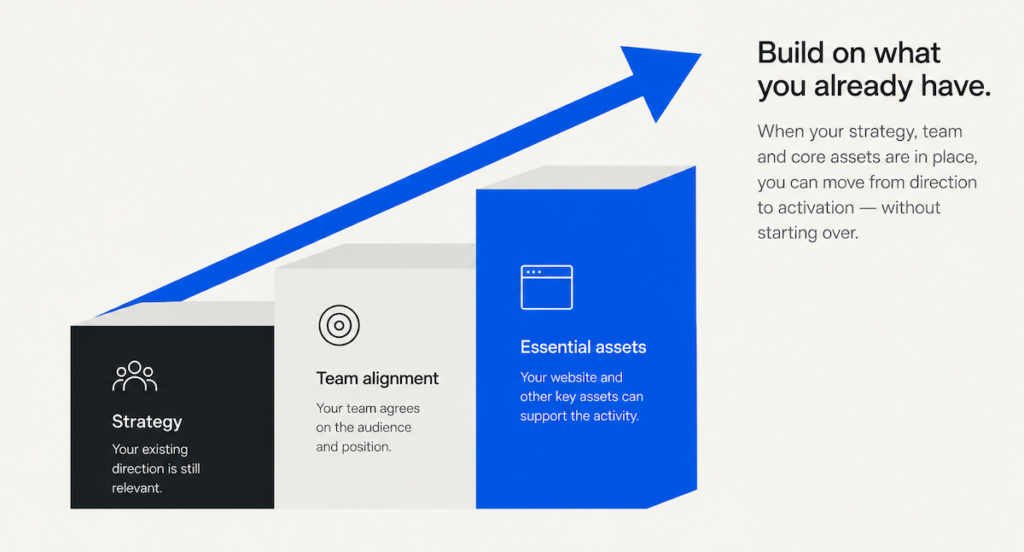
Before launching, check that the people creating campaigns can answer three questions consistently: Who is this for? What should they understand about us? What action do we want them to take? If those answers are clear, a targeted campaign or ongoing content programme can be scoped around the business goal. Activation can also reveal where a message or asset needs refinement; that does not automatically mean the entire strategy is wrong.
When should you revisit brand strategy first?
Revisit strategy when important decisions are unsettled. If leaders describe the business differently, cannot agree on the priority audience, or are unsure how the offer differs from alternatives, more marketing may spread that uncertainty rather than resolve it. A shift in services, audience, or market is another reason to test whether the existing position still fits.
Strategy work can establish the evidence and agreement needed to make subsequent choices: what the business stands for, which audiences matter, how to position its offer, and where to focus. It need not imply a complete rebrand. The scope may be a focused review of an existing strategy rather than a new strategy from the ground up.
What if the strategy is clear but the brand assets are not?
Address the relevant parts of Brand Foundation before asking those assets to carry a larger campaign. For example, a clear position is harder to communicate if the website describes an old offer or sales materials tell a different story. The answer may be a website or collateral update, not another round of positioning work.
For a growing business, a practical sequence is:
- Confirm the direction. Check whether leadership agrees on the audience, offer, and position, and whether those choices still fit the market.
- Inspect the foundation. Review the identity, website, and essential materials against that direction. Update the assets that would otherwise create confusion.
- Plan the activation. Choose campaigns, content, or ongoing marketing based on the audience and the action you want people to take.
- Review what you learn. Use feedback from the work to refine execution—and revisit strategy if it exposes a more fundamental change in the business or its audience.
A quick decision checklist
- Can our leadership team explain our position in the same way? If not, start with strategy.
- Do we know which audience we are prioritizing and why? If not, investigate before choosing channels or campaigns.
- Does our current strategy still match our offer and market? If not, review it before expanding marketing.
- Do our website and key materials reflect that strategy? If not, scope the necessary foundation work.
- Can we state a specific goal for the marketing activity? If yes—and the direction and assets are sound—scope activation.
You do not need to solve every brand question at once. You do need enough clarity to make the next investment purposeful. If the answer is mixed, tell The REX Agency what has changed and what you are trying to achieve so the first piece of work can be scoped around the actual gap.
FAQ
Does every activation project require a new brand strategy?
No. If your existing strategy is clear, current, and shared by the people doing the work, activation can build on it. Review the strategy first if the business, audience, or position has changed enough to make that direction unreliable.
Is a new logo part of brand strategy or brand activation?
A logo belongs to Brand Foundation, not to strategy or activation by itself. Strategy informs what the identity needs to communicate; activation uses that identity in marketing. A logo change is not necessary simply because you are starting a campaign.
Can we run marketing while reviewing our strategy?
Yes, where the activity has a clear purpose and does not depend on a disputed position. Keep the scope deliberate: maintain what your business needs now, and avoid committing to a larger campaign or new assets until the strategic questions affecting them are resolved.