
The Marketing Spend Trap: Why the Cost Per Lead Keeps Rising
Being a marketer, I often get calls from friends and family with questions like these:
“How much would it cost to run ads on Facebook?”
“How many leads can I get from running ads on Google?”
“Here is my business plan, can you run some ads and get me some leads?”
These are all genuine questions. Over the years they have become more frequent, and my answers have become more complex.
Why does the cost per lead keep rising?
The cost to get a lead on a digital platform (Google, Meta, and the rest) has climbed over the past five years, even though platforms keep promising better targeting. Here is the average cost per lead (CPL) for pay-per-click advertising since 2020:
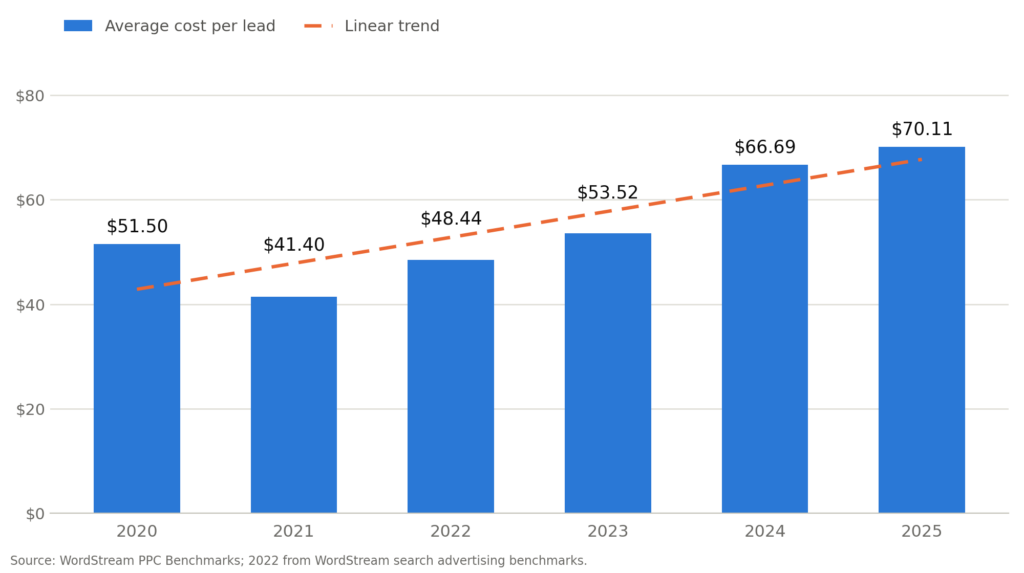
Source: WordStream PPC Benchmarks; the 2022 figure is from WordStream’s search advertising benchmarks.
A word of caution on that data. Cost per lead only measures what it takes to get someone to fill out a form or hit a call button. That person may or may not be right for your business. The cost of one good, aligned lead is much higher than the numbers above suggest, because a marketing qualified lead still has to be qualified again by sales before anyone knows if the campaign actually worked.
The point I am trying to make is that hedging your brand’s success on paid ads isn’t the best way to solve a growth problem.
Why are the platforms getting more expensive?
Part of this is simple auction math. More advertisers are competing for the same inventory, and the price of that inventory moves with them. Threadpoint, an agency that tracks both Google and Meta accounts, found Meta CPMs (cost per thousand impressions) up about 13 percent year over year in 2026 across its own accounts. The Ryze 2026 Meta Ads benchmark puts the industry-wide increase at 20 percent, with the average CPM climbing from about $11.82 to $14.19.
eMarketer forecasts that Google will earn 48.5 percent of US search ad spending in 2026, the first time in more than 20 years it has fallen below half, with Amazon taking the biggest share of the difference. Budgets are spreading across Google, Meta, Amazon, and other retail media networks. When more advertisers spread across more platforms and every one of those auctions gets more competitive, rising costs follow. This isn’t a new pattern, either. WordStream’s 2022 search advertising benchmarks found cost per lead rose 19 percent across the industries it tracked, with conversion rate falling 14 percent over the same period.
How are AI tools changing where leads come from?
Google Search is under its own pressure. A study by Seer Interactive, found that Google’s AI Overviews have cut organic click-through rates by close to two-thirds on the queries where they appear, and paid click-through rates fell about a third even on searches without them. When the answer shows up on the results page itself, fewer people click through to anything, paid or organic, so every click that does happen costs more.
It also means the competition for attention isn’t just other advertisers anymore. Large language model (LLM) tools like ChatGPT, Gemini, Perplexity, and Google’s own AI Overviews are increasingly where people go for an answer instead of clicking through to a website at all. That attention is leaving the ad auction and the organic results entirely. There is no proven playbook yet for how these tools decide which brands to mention. What a business can control is whether it is clearly understood, by the people it wants to reach and by the tools that summarize it. That clarity comes from the same brand foundation work that makes marketing convert.
None of this is a business owner’s fault, and none of it is reversing. More advertisers, tighter privacy-driven targeting, and AI tools absorbing a chunk of search intent all point the same way: paid acquisition costs more today than it did five years ago, and it will likely cost more again five years from now.
Why do weak brand foundations make leads cost more?
Platform inflation isn’t the only reason the same dollar buys less than it used to. A lot of the rise is self-inflicted, and it happens upstream of the ads themselves.
Plenty of businesses start marketing without answering the questions that should come first: who the business serves, why that person should choose them over the alternative, and what the brand looks and sounds like when it shows up consistently. Without that foundation, an ad can only do one job well, which is get clicks. It can’t do the second job, which is convince the right person to act and the wrong person to move on.
That’s where the real cost hides. A generic ad pulls in a wide, low-intent audience. Some of them convert anyway, because enough volume converts something, but the conversion rate is lower than it should be, so the same spend produces fewer leads. Worse, the leads who do convert are often not the right fit. They saw an offer, not a business they understood, so they show up with the wrong expectations. Sales spends more time qualifying and disqualifying. Delivery spends more time managing a client who never should have signed. None of that cost shows up in the campaign numbers, but all of it traces back to them.
Picture two businesses spending the same $1,000 on ads. One has a clear strategy, a consistent visual identity, and messaging that speaks to a specific customer. The other is running ads with no brand work behind them. Same platform, same budget, same auction. The first business converts more of its traffic and attracts people who already understand what they’re buying before they inquire. The second gets a similar number of clicks for a similar price, a worse cost per lead, and a portion of leads who never should have been in the funnel.
What does brand strategy actually change?
We saw a version of this with Perfect Fit, a mechanical services company that had outgrown its brand. It had multiple company names, overlapping services, and an unclear customer journey. REX built a unified brand architecture, a new visual identity, and a new website around the two audiences it actually served, home service customers and commercial clients. Here is what their ads manager told us after the new site launched:
Ever since the new site launched, the quality of leads have gone up noticeably. No more spam submissions, or people asking for small jobs. It’s been mostly big ticket items like Poly B, boilers and heaters. — Perfect Fit ads manager
Notice what moved. It wasn’t the cost per lead. It was who was filling out the form. That is the point I made earlier: the cost per lead says very little about whether the lead was worth having.
This is where brand strategy earns its keep in a way that’s easy to undersell. Most founders come to marketing wanting leads this month, which is a fair thing to want when payroll is due. But a founder chasing leads and a founder with a strategy are answering two different questions. One is asking how to fill the pipeline right now. The other has already answered who they serve, why those people should choose them, and what the business is building toward, so the pipeline fills as a byproduct instead of the entire goal. That shift, from a month-to-month lead count to a defined direction, is what lets a business grow at a pace it can sustain, rather than one it has to keep buying with an ever-larger budget.
It’s also not a new idea. Les Binet and Peter Field’s The Long and the Short of It, published by the Institute of Practitioners in Advertising (IPA), examines the tension between short-term response activity and long-term brand building. It warns that leaning on very short-term online metrics as the main measure of performance has dangerous implications for long-term success. Their work is often summarized as a rough 60/40 split between brand building and activation, with the ideal ratio varying by category. Binet has also said that strong brand building tends to lift the results of short-term activation, which is exactly what you want when the cost of attention keeps climbing.
How does brand strategy help you keep the leads you already paid for?
Most of the conversation around cost per lead stops at acquisition. But a lead that was never nurtured is a lead paid for twice, once to acquire and again when a competitor picks it up later. Research from MarketingSherpa puts the share of marketing leads that never convert into sales at roughly 79 percent, with poor lead nurturing as the most common cause. It’s an older stat, but the point it makes still holds: a lead that isn’t followed up well is money already spent.
Strategy is what makes nurturing work, because it decides who you are nurturing and what you say to them. A good strategy defines your Ideal Customer Profile (ICP), the type of customer who gets the most value from what you offer and is the best fit for your business. It also defines your perfect paying customer, the person who values your work, pays fairly for it, and is a pleasure to serve. Once you know who that is, you can learn what their needs and challenges really are, and that shapes everything after the first inquiry: what you send, when you follow up, and what you offer when they aren’t ready to buy yet. Without it, follow-up is generic, and generic follow-up is easy to ignore. With it, more of the leads you already paid for turn into customers, which is a cheaper fix than outbidding everyone else for more traffic at the top.
Does standing out still matter when every ad looks the same?
There’s a newer pressure sitting on top of all of this. AI tools have made it easy for any competitor to produce a decent-looking ad in minutes, and more businesses are doing exactly that. The result is a feed where more of the ads look similar, sound similar, and say roughly the same thing, because they were built the same way. When every option in a category looks interchangeable, the deciding factor for a prospect stops being the offer and starts being which business they recognize or trust. A brand with a distinct point of view, consistent visuals, and a voice that sounds like an actual business rather than a template stands out precisely because most of what competes for that attention doesn’t. That’s a second return on brand work beyond conversion rate: it makes a business recognizable in a market that is getting more automated and more uniform.
So what is the marketing spend trap?
This is the trap: Cost per lead rises, so the instinct is to spend more or add another channel. Meta isn’t converting, so try Reddit. Reddit isn’t converting either, so add Linkedin. Each new channel buys another round of clicks, but without a right foundation it’s the same low-conversion math in a new place. The spend climbs, the lead count becomes the only measure of success, and the question that matters, whether these are the right customers and why they would choose you, never gets asked.
Ads or no ads, what makes marketing perform?
Everything above is about paid ads because that’s where the cost is easiest to see. But the argument isn’t really about ads. Platforms will keep getting more expensive, AI tools will keep changing how people find businesses, and new channels will keep appearing and getting crowded. A business that builds its marketing around any one of them is building around something it doesn’t control.
What it does control is the thing every channel draws on: who it serves, why those people should choose it over the alternative, and how it shows up when they look. Brand strategy is that decision, made deliberately. It’s what gives a website its point of view, a sales conversation its footing, a referral its reason, and an ad its edge. It’s also what lets a business’s marketing hold up when the platforms change, because the customer and the message stay the same even when the channel doesn’t.
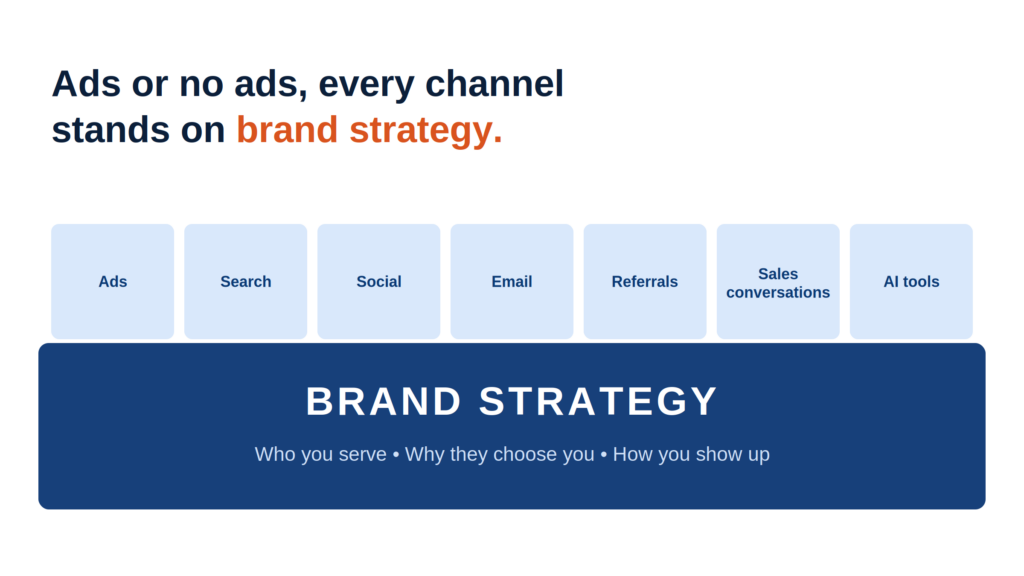
That is why marketing performance peaks when a brand strategy is in place, whether the budget goes to ads, search, social, email, or none of the above. Without one, every channel has to work out the audience and the message on its own, and every tactic starts from zero. With one, every channel starts from the same clear position, and each one makes the others work harder.
Those three questions I get from friends and family come down to one: will marketing work for my business? The honest answer isn’t a platform or a budget. It’s whether the business has decided who it is for and why it’s the right choice. Ads can rent attention. Brand strategy is what makes a business worth the attention it gets.