

Brand Foundation vs Brand Strategy: What Comes First?
Brand Strategy comes first when your business has not settled who it serves, how it differs, or what it needs to communicate. Brand Foundation then turns that direction into a usable identity, website, and other brand assets. If your existing strategy still fits, you may not need to redo it: assess the assets against it and improve what no longer works.
For a growing business, the question is less “Which deliverable should we buy?” and more “Do we know what the deliverables need to say and do?”
Brand Strategy vs Brand Foundation at a glance
| Brand Strategy | Brand Foundation | |
|---|---|---|
| Core question | Who are we for, what makes us distinct, and where are we going? | How will people recognize, understand, and experience that direction? |
| Work involved | Discovery, audience and market research, positioning, and strategic planning | Identity, website, and practical assets that express the strategy |
| Examples of outputs | Positioning, audience insights, strategic narrative, and messaging direction | Logo and visual identity systems, website, presentations, signage, and other materials selected for the business |
| Check for success | Leaders can make consistent decisions about audience, offer, and message | Teams can apply those decisions consistently across relevant touchpoints |
At The REX Agency, Brand Strategy establishes the direction, while Brand Foundation builds the identity and assets that put it into use. They are connected stages, not interchangeable names for a logo project.
Which comes first for your business?
Start with Brand Strategy if the underlying decisions are unsettled. Perhaps your leadership team describes your ideal customer differently, your service offering has changed, or your website cannot explain why someone should choose you. Discovery and research can establish a direction before you commission a new identity or rebuild the site.
Start by reviewing the existing strategy if those decisions have already been made. Ask whether the audience, positioning, and business direction still reflect what you offer and where you intend to grow. If they do, move to a focused Brand Foundation audit rather than assuming you need a complete strategic restart.
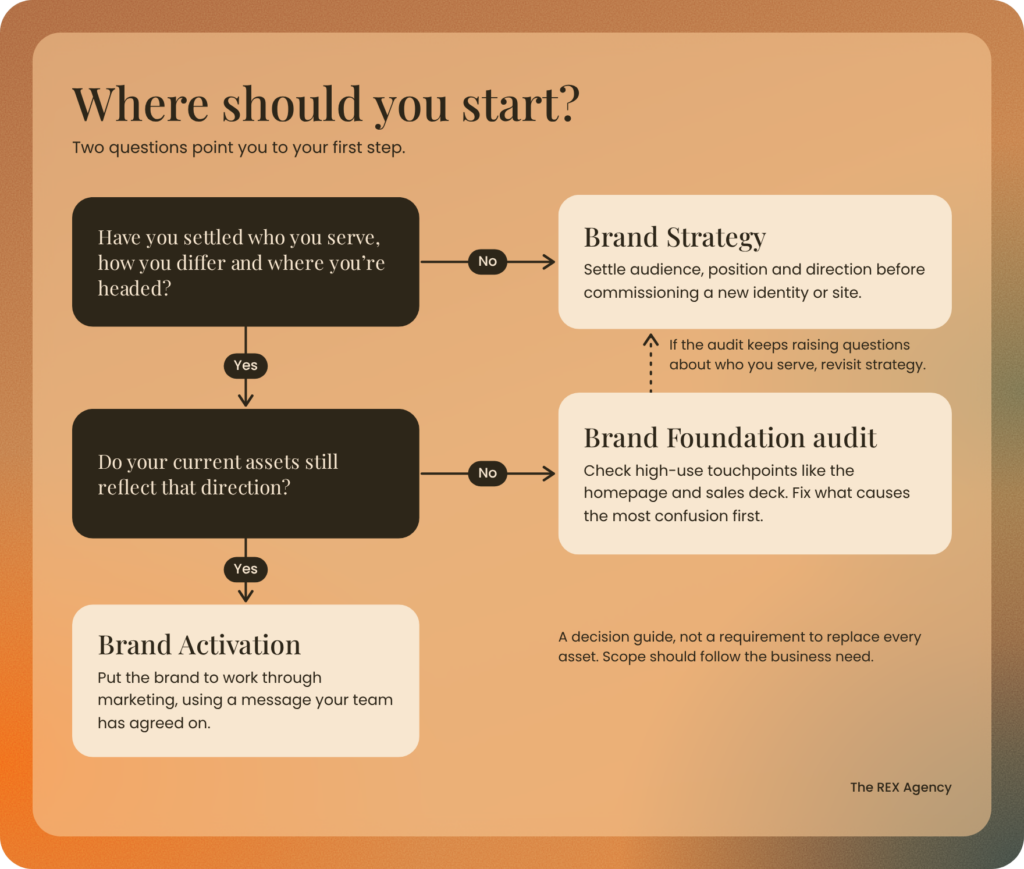
For example, imagine a Canadian professional services firm that has agreed on its audience and position but still sends proposals built for an older, broader offer. The immediate need may be clearer proposal materials and website copy—not new positioning. By contrast, if its partners disagree about which clients the firm should pursue, designing those materials first would lock in an unresolved decision. These are hypothetical situations, not client outcomes.
How do you tell whether your current assets still fit?
Compare the strategy with the places customers and employees actually encounter the brand. Choose a small set of high-use touchpoints—such as the homepage, a sales presentation, a social profile, and an employee welcome kit—and ask:
- Audience: Is each asset speaking to the people the strategy prioritizes, or to an audience the business has moved beyond?
- Positioning: Can someone understand the distinct value of the offer without relying on a salesperson to explain it?
- Consistency: Do the words, visuals, and service descriptions tell the same story across touchpoints?
- Usability: Can your team update and apply the assets without recreating them each time?
- Fit: Does the customer experience match what your brand promises?
Record the mismatch and its consequence. “The proposal names services we no longer lead with” is more useful than “the deck feels dated.” If the strategy holds up but the assets do not, prioritize the touchpoints that cause the most confusion. If the audit repeatedly raises questions about whom you serve or what you stand for, revisit strategy before redesigning everything.
Sequencing mistakes to avoid
- Commissioning a new look before agreeing on a position. A design brief cannot settle a disagreement about audience or offer. Make those choices first.
- Treating every outdated asset as evidence of a broken strategy. A sound position can be expressed through an ineffective website or inconsistent collateral. Test the direction before discarding it.
- Updating one asset without planning how others will be used. A new website alongside old proposals and signage can leave teams telling different stories. Identify the touchpoints that need to change together.
- Moving into campaigns before the message and materials are ready. Brand Activation puts the brand to work through marketing; it is easier to plan when the direction is clear and the assets needed to communicate it are usable.
The sequence is a decision guide, not a requirement to replace every asset or undertake every service. Scope should follow the business need.
FAQ
Can we keep our current logo and still improve our Brand Foundation?
Yes. If the logo supports your positioning and works across the places you use it, other assets may deserve attention first. Check the website, messaging, presentations, and brand guidelines before deciding what to retain or change.
Do we need a full Brand Strategy project if we already have one?
Not necessarily. First confirm that your existing strategy still reflects your audience, offer, and direction. If it does, a targeted audit can identify which Brand Foundation elements need work; if it does not, clarify the strategic decisions before rebuilding assets.
Where does Brand Activation fit?
Brand Activation follows the direction set by Brand Strategy and uses the Brand Foundation to communicate it through marketing and campaigns. You can review existing marketing while making earlier decisions, but avoid scaling activity around a message your team has not agreed on.
If you are unsure whether the gap is strategic or practical, inquire with The REX Agency about a needs assessment. Bring your current strategy, a few commonly used assets, and the decisions your team is struggling to make.